Reflections from COP30 Belém, Brasil
Eva Mineur, Head of Climate and Sustainability at GCF was in Belém for COP30. Read her takeaways and thoughts after the 30th edition of the UN's Climate Change Conference
COP30 in Brazil came at a difficult moment for global cooperation. Brazil’s ambition was clear: to revive a sense of purpose at a time when the UN system is under pressure and climate politics are increasingly fragmented. What I took away, is that at a time when global governance is fragile, it is the quality of our stewardship that determines the impact of climate action. That is how we govern, how we uphold institutions and how we build trust at every level.
This became especially clear in the roundtables and panels I participated in. Again and again, discussions on climate finance and adaptation circled around budgets, justice, and community participation. All of these matter deeply. But too often the conversation stopped there, without addressing the mechanism that turns ambition into lived change: governance. Effective institutions, transparent processes, and independent oversight create the real capacity for local ownership and meaningful participation. They are what allow finance to flow, policies to be implemented, and communities to trust the systems meant to serve them. Without strong institutions, even the best-funded initiatives risk stalling. With it, resilience and transition can reinforce each other. And they must, because resilience without transition is impossible, and transition without resilience is unjust.
Brazil tried to steer the COP toward renewed cooperation. But it was also clear that the UN climate process is entering a challenging era with geopolitical fragmentation, competing crises, and declining trust that are testing its capacity. As Johan Rockström said, “COP30 was declared to be the COP of ‘truth and implementation’. Scientifically, this was an appropriate label. But leaders gathered in Belém failed to fulfill this promise”. The big question is not whether COPs will continue, but how the meetings will manage to evolve into the implementation decade. Will the parties be able to deliver frameworks that countries and non-state actors can actually operationalize? That remains to be determined.
One of the most important developments was the continuation of the process into 2026 to create a roadmap that phases out fossil fuels, with Colombia taking the lead. This shows that determined countries can shift the centre of gravity even when larger economies hesitate. Leadership now comes from those willing to act.
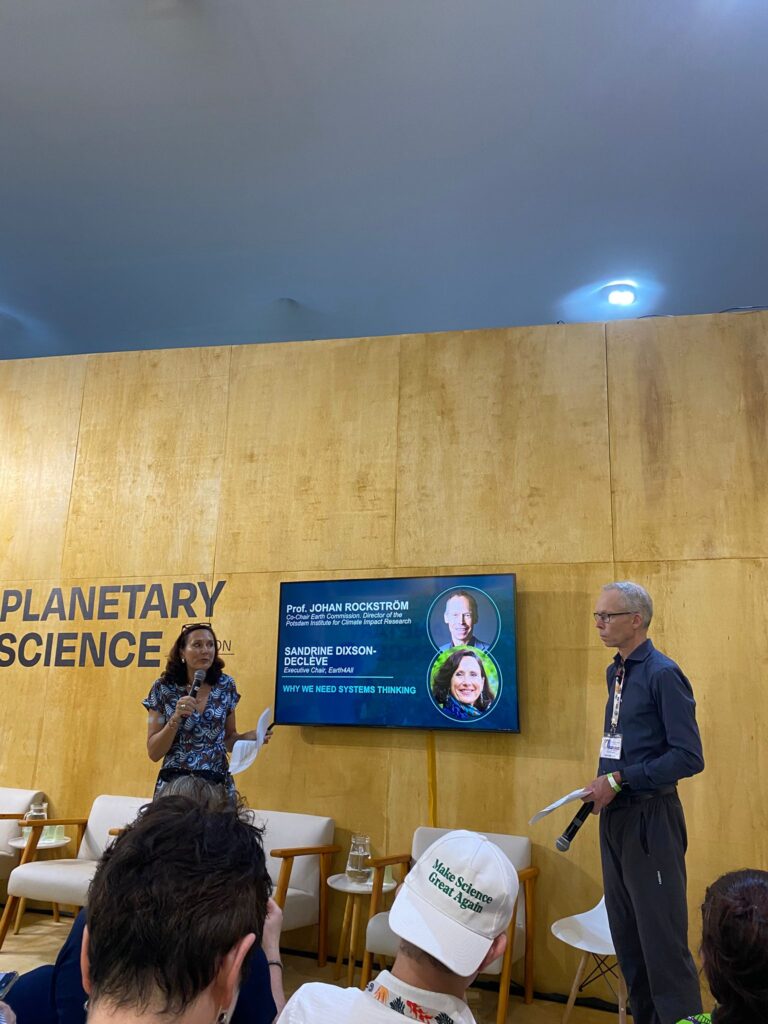
Sandrine Dixson-Declève and Johan Rockström during a talk at the Planetary Science Pavilion at COP30 in Belém, Brazil.
As I left Belém and reflected on these conversations, three themes stood out that will shape the climate agenda in the years ahead:
1. Climate leadership now depends on coalitions of the willing
Formal negotiations matter, but real momentum now comes from countries and actors prepared to move ahead. Colombia’s role in the fossil phase-out process could be decisive and may prove pivotal in maintaining pressure where political will is wavering!
2. Governance is climate action
Strong institutions, accountability, and transparent systems are the enabling conditions for climate finance, mitigation, and adaptation. They create trust, and trust is what allows impact to scale. Yet this perspective was largely missing in Belém. We need to bring governance back to the centre if we want climate efforts to deliver real results.
3. Science must stay at the centre
The Science Pavilion led by Johan Rockström and colleagues, supported by us, ensured that planetary boundaries and new research remained visible throughout the conference. In a time of rising misinformation and political volatility, anchoring decisions in science is not optional. A more elaborate science-policy interface, at all levels, is more important than ever to support.
A final note:
Meeting our partners in person was one of the true highlights. Their commitment and creativity are inspiring, and I left Brazil with new insights and a renewed sense of shared purpose. Hope, right now, is not optimism; it is the decision to keep building. And I am proud that even in a fractured world, GCF and many others continue to actively choose to strengthen the institutions, alliances, and scientific foundations that make progress possible.