A system under stress: Adapting global governance to a world of accelerating risk
As this report shows, outdated governance, rising geopolitical tensions and fragmented institutions leave humanity exposed. Addressing escalating systemic threats requires renewed legitimacy, stronger cooperation and a more adaptive, anticipatory global governance architecture capable of managing shared risks.
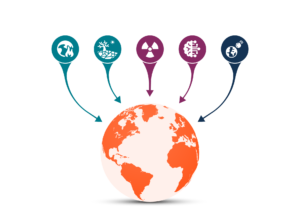
One of the main privileges of working for an organisation that covers a broad range of global risks is the bird’s eye view you get across issue areas and political processes. As this report shows, we are witnessing fundamental shifts in how global risks emerge, expand and interact, spanning climate, ecosystems, technology and security domains.
In the security sphere, states’ drive for technological and strategic advantage is reshaping deterrence and altering pathways of escalation. As Wilfred Wan observes, the deepening entanglement of nuclear and non-nuclear capabilities across domains, such as cyber and outer space, blurs thresholds and increases the risk that misperception or technical failure could trigger unintended — even nuclear — escalation.
In addition, as Denise Garcia notes, diplomatic and regulatory processes remain too slow and fragmented to match the speed of technological change, such as the rapid integration of AI into military command and control. Once embedded, these technologies are extremely difficult to constrain, leaving the world to play catch-up with risks that evolve faster than the rules meant to contain them.
In the environmental sphere, a similar pattern of interconnected fragility applies. Climate change, biodiversity loss, and resource competition interact in non-linear and cascading ways, creating pressures that destabilise both natural systems and societies. Today, we stand at what David Obura and others call a bifurcation point. A growing number of ecosystems, from coral reefs and moun-tain glaciers to freshwater systems, are nearing thresholds of collapse driven by climate change, land-use conversion, and over-extraction. As Johan Rockström and Fatima Denton highlight, seven of the nine safe and just Earth-system boundaries have already been transgressed, creating devastating and unjust socio-economic consequences that quickly outpace our preparedness.
The Earth system moves as a whole; the loss of a rainforest or coral reef sends systemic ripples through climate, food, and water systems.
We treat each of these crises as if it were separate: one agency for forests, another for oceans, a third for emissions. Yet the Earth system moves as a whole; the loss of a rainforest or coral reef sends systemic ripples through climate, food, and water systems.
At the same time, rising geopolitical tensions, resurgent nationalism and vested interests drive competition and unilateral action instead of cooperation. Our collective capacity to mitigate global catastrophic risks and protect both people and planet remains weak at best, while trust in and the legitimacy of the system is eroding. Even where institutions exist, from the UN Security Council and the International Criminal Court to the multilateral environmental regimes, their ability to act is constrained by political gridlock, weak enforcement and chronic underfunding.
Our perception of risk remains uneven, and our governance fragmented. As Romana Kofler notes in her article, for near-Earth asteroids, the world mobilises a coordinated international response when the probability of impact exceeds just one percent. Yet, for Earth-system tipping points like a potential AMOC collapse, where risk is far higher and consequences equally globally catastrophic, no comparable governance mechanisms exist. As this case illustrates, and as the GCF’s founder László Szombatfalvy often noted, low-probability but high-impact events constitute potential extreme-risk scenarios that we are not yet equipped to manage at the global level.
Across most of the domains, the underlying dynamics are the same, including ineffective governance, weak accountability and a lack of multilateral coordination. This leaves humanity and the planet exposed. The rules written for a stable world no longer fit the one taking shape before us. If the international system cannot evolve to meet both existing and new kinds of global catastrophic risks, how can it maintain legitimacy?
A system fit for purpose
The GCF’s long-term goal is to help build a legitimate, effective, and just global governance system. One capable of preventing and managing global catastrophic risks through stronger international law, more effective multilateral institutions and decisions grounded in science. To move this vision forward, we focus on catalytic partnerships between research, civil society and policymakers; network-building across North and South; and policy engagement in global processes and forums such as the UN, G20, BRICS+ and other minilaterals.
We see change as a process that unfolds along parallel tracks. While some institutions adapt from within, new networks, ideas and practices take shape alongside them — testing alterna-tives, demonstrating what works and gradually redefining what is possible. GCF helps develop these emerging solutions and connects them to decision-making arenas, increasing demand for reform, supporting coalitions of the willing and strengthening coordination across silos to reveal how risks intersect.
What we need now is a renewed approach to global governance. One that reinforces international law, strengthens shared norms and accelerates action, while simultaneously fostering creativity, innovation and foresight. It means acting on today’s urgent risks while reimagining the systems that must guide us through what comes next.
We recognise that this work takes place in a deeply challenging political landscape. Change at this scale is hard, slow and rarely linear. Yet even in this environment, there continues to be space for progress, often in unexpected places. Our task is to help protect what works, support what is emerging and show that re-newal of global governance is still possible.
Informed by the insights from this report, we see three major shifts that can help advance that renewal.
What we need now is a renewed approach to global governance. One that reinforces international law, strengthens shared norms and accelerates action, while simultaneously fostering creativity, innovation and foresight.
Shift 1: From fragmentation to connection and adaptability
As risks become increasingly interdependent, cooperation remains fragmented and siloed. Financing mechanisms, including philanthropy, often mirror this fragmentation, producing governance structures that reflect, rather than resolve, global division.
States, institutions and funders must work together to build bridges between systems so we can manage global risks as the interconnected challenges they are. Many of GCF’s partners already demonstrate this: the Earth Commission maps interconnections across planetary systems, while SIPRI explores how risks across cyber, space and nuclear domains intersect and create new escalation pathways.
Governance must move from crisis response to anticipatory stewardship, embedding foresight, early warning systems and risk reduction into decision-making. As Manjana Milkoreit argues, imagination is not an escape from reality but the engine for improved governance. Without it, we drift from crisis to crises; with it, we can orient ourselves toward futures still within reach.
This requires institutional creativity and GCF’s partners are already experimenting with such innovations. For example, the Igarapé Institute is exploring a Global Climate and Nature Council, the United Nations University Centre for Policy and Research is advocating for a UN Future Generations Commissioner, and Democracy Without Borders and ISWE Foundation are developing innovative mechanisms for citizen participation. Taken together, these initiatives demonstrate how creative thinking and practical experimentation can open new pathways for global governance to evolve.
Governance must move from crisis response to anticipatory stewardship, embedding foresight, early warning systems and risk reduction into decision-making.
Shift 2: From erosion to legitimacy
How do we defend what works while acknowledging what does not? In a divided world, we must uphold the rules we have created, even as we confront the double standards — particularly the selective respect for international law that has undermined the system’s credibility and trust it depends on.
Strengthening the anchors of global governance — accountability, implementation and international legal frameworks — starts with renewing our commitment to the idea that rules matter, even when inconvenient. International courts and accountability mechanisms need independence, resources and political backing. States must honour their commitments, defend institutions under pressure and lead by example. But states cannot do this alone. Civil society plays a crucial role, holding governments accountable, keeping attention on overlooked crises and defending international law, often with shrinking space and resources. Protecting those who defend the rule of law is as vital as safeguarding the institutions themselves.
In addition, the system must evolve, reforming what exists when needed and filling the gaps. This includes modernising international law. Among GCF’s partners, Article 36 advances efforts for a new legal instrument on autonomous weapons; Stop Ecocide International campaigns to make ecocide the fifth international crime under the Rome Statute; and the European Centre for Constitutional and Human Rights pushes to close accountability gaps for the crime of aggression. Together, these efforts show that progress requires both protecting existing foundations and advancing bold reforms.
Shift 3: From imbalance to inclusion
Global governance systems still reflect deep historical imbalances. From the veto-weighted structure of the UN Security Council to climate finance arrangements where those least responsible for the crisis are often left most exposed to its consequences. The experiences and capacities of the Global South are essential for shaping systems that are more adaptive and legitimate, yet its influence remains limited in many key decision-making processes. This imbalance fuels mistrust, weakens ownership and undermines both legitimacy and effectiveness.
Strengthening global governance also means confronting the structural imbalances of power and finance that have long constrained equitable decision-making. Justice and inclusion must be structural principles; fairness, participation and representation are not moral ideas alone but practical requirements for legitimacy. Through the Article 109 coalition and the Global Governance Forum we are supporting efforts to reform the UN Charter, including the Security Council. Meanwhile, the International Peace Institute, European Institute of Peace and Plataforma Cipó are strengthening trust by facilitating dialogue and cooperation between the most vulnerable states and key actors in an increasingly polarised world.
Where to go from here
As the Global Catastrophic Risks Report 2026 makes clear, the system of global governance built to manage shared risks is under immense strain. Yet it remains indispensable for navigating an increasingly complex and interconnected world.
Rather than turning inward toward nationalism and isolation, we must rebuild trust in the rules, institutions and norms that still hold while modernising them to meet new realities. Strengthening accountability, reforming international law and giving global systems the capacity to act is essential to restoring legitimacy and effectiveness.
The challenges ahead are significant. However, they also offer an opportunity to rethink how we cooperate on a shared planet and to reimagine a global governance system fit for the risks and realities of our time and those still to come.

Head of Climate and Sustainability, GCF

Head of Common Security GCF

Head of Programmes GCF
Explore the report
Forward
It may sound a bit boring, but I am a big fan of rules. From dividing a cake, to how…

Earth System Stability
A stable Earth system is vital for a safe and just future We are pushing the planet beyond the limits…
Catastrophic Climate Change – overview
What is the risk? Climate change is the long-term alteration of the Earth’s climate system, driven primarily by the accumulation…

Ecological Collapse – overview
What is the risk? These systems can tolerate some impact from human use and recover after a period of time…

Weapons of Mass Destruction – overview
What is the risk? Hostile geopolitical relations and the deteriorated strategic context are eroding the structures that govern the world’s…

Artificial Intelligence – overview
How is AI integrated in military decision-making? Several countries now incorporate AI into their military operations through decision support systems…

Near Earth Asteroids – overview
What is the risk? NEOs, asteroids and the occasional comet, are objects that travel close enough to Earth’s orbit to…