It may sound a bit boring, but I am a big fan of rules. From dividing a cake, to how we regulate the use of advanced technology. Rules offered protection for me as I was the smallest in the classroom and the youngest of my siblings. When handling conflicts, a rules-based order is a good thing for us who reject the idea that “might is right”. It offers a kind of protection when choosing a stance in a power game and might even give us a say in creating those rules.
Our planetary commons — the shared systems that sustain life — have a weak voice in our decision-making systems. Space, the deep sea, freshwater, forests, and ice are not the infinite resources we once imagined but are part of a delicate balance, providing us with a life-sustaining environment. Never did I think that the Greenland Ice Sheet had anything to do with my future. Yet, human activities have affected ice sheets and other commons to such a degree that they will, inevitably, affect us all.

Strategic Advisor, Global Challenges Foundation
Welcome to the Global Challenges Foundation’s (GCF) Global Catastrophic Risks report 2026
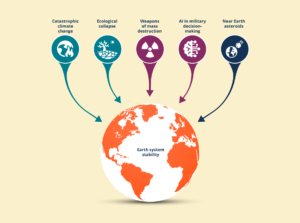
In the following articles, we present today’s most threatening global catastrophic risks against human life on Earth. This is an exercise we have been doing since GCF was founded by László Szombatfalvy in 2012. As Johan Rockström and Fatima Denton describe in the chapter on Earth system stability, each of the risks described are deeply interconnected. Man-made risks such as climate changes, biodiversity collapse, weapons of mass destruction and the military use of artificial intelligence (AI) cannot be addressed in isolated silos. As climate and environment become increasingly intertwined with peace and security, we need a paradigm shift in international cooperation — one that bridges silos and reflects today’s interconnected risks.
Each section of this report highlights a different risk. Each risk section begins with a two-page overview of the background, current development and existing governance — or the lack of it. This is followed by an article exploring a specific theme concerning the risk and potential pathways forward. The articles are written by some of the world’s most recognised scientists and experts in their fields. That does not mean that we are turning away from other voices, perspectives and solutions. On the contrary, the purpose of this report is to stimulate open debate on how to understand, address and mitigate these risks. Civil society must be part of policy-making to protect ecosystems, and non-nuclear states must have a voice in nuclear risk-reduction discussions — especially those already affected by cross-border threats.
Measures to adapt the current system of multilateral co-operation to handle these risks are seldom straightforward. Our patterns of production and consumption, as well as our ability to prevent and handle conflicts, remain misaligned with a sustainable and safe world. It can be tempting to seek purely technical solu-tions or attempt to out-arm one’s neighbour.
We can see this today in the ongoing arms race around autonomous weapon sys-tems. Establishing a meaningful, legally binding instrument to govern autonomous weapons development and use feels as urgent as it is complex and difficult. Addition-ally, our planetary commons cannot be negotiated with. The Greenland Ice Sheet, for example, does not respond to threats but to temperature.
Meaningful steps have been taken before and can be taken again. At the end of this report some of my colleagues draw conclusions and give recommendations on the multilateral management of these risks. Humans are a remarkably adaptable species, and the Earth, with its built-in resilience, still offers us a window of opportunity — let’s embrace it together.

Global Challenges Foundation was founded in 2012 by the Swedish Financial analyst and author László Szombatfalvy (1927-2022).
Explore the report
Earth System Stability
A stable Earth system is vital for a safe and just future We are pushing the planet beyond the limits…
Catastrophic Climate Change – overview
What is the risk? Climate change is the long-term alteration of the Earth’s climate system, driven primarily by the accumulation…

Ecological Collapse – overview
What is the risk? These systems can tolerate some impact from human use and recover after a period of time…
Weapons of Mass Destruction – overview
What is the risk? Hostile geopolitical relations and the deteriorated strategic context are eroding the structures that govern the world’s…
Artificial Intelligence – overview
How is AI integrated in military decision-making? Several countries now incorporate AI into their military operations through decision support systems…

Near Earth Asteroids – overview
What is the risk? NEOs, asteroids and the occasional comet, are objects that travel close enough to Earth’s orbit to…
Conclusion – Reflections from GCF
A system under stress: Adapting global governance to a world of accelerating risk As this report shows, outdated governance, rising…