Multi-Domain Escalation Risk
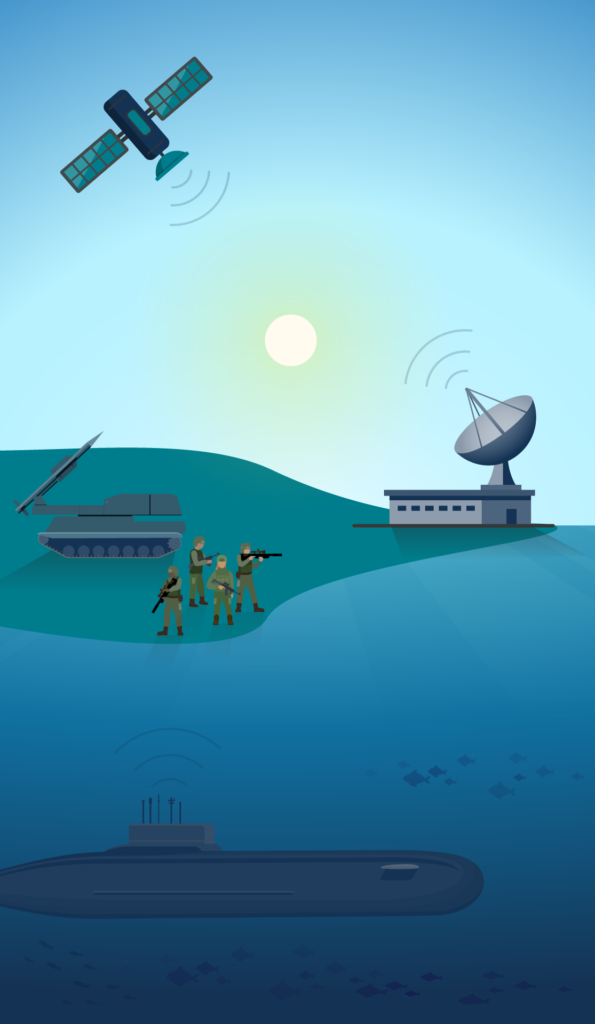
Rapid technological advances and expanding multi-domain warfare are reshaping global security, blurring lines between nuclear and conventional conflict. As cyber, space, artificial intelligence (AI) and disinformation capabilities converge, escalation risks grow increasingly unpredictable. Understanding these dynamics is essential for strengthening governance, preventing miscalculation, and reducing the mounting danger of nuclear use in a volatile strategic environment.


Wilfred Wan is the Director of the Stockholm International Peace Research Institute (SIPRI) Weapons of Mass Destruction Programme. His recent research focuses on nuclear weapon risk reduction, nuclear disarmament verification, and other issues related to arms control and disarmament.
Recent and ongoing conflicts demonstrate the increasingly complex nature of contemporary warfare. Modern warfare now encompasses multiple operational domains and features the convergence of advanced technological capabilities. For instance, on the eve of the full-scale Russian invasion of Ukraine in February 2022, a massive cyber operation was attributed to Moscow by the European Union, the United Kingdom and the United States. The operation targeted Viasat’s KA-SAT network — disrupting broadband satellite access, internet access and critical infra-structure across Ukraine. In the ensuing war, Ukraine has arguably achieved its greatest battlefield success through the large-scale use of drones likely trained by AI. For instance, a June 2025 attack from Ukraine resulted in damage to over 40 Russian strategic bombers in air-fields across the country — undermining Russia’s nuclear forces in the process[1] Israel’s military campaign in Gaza since October 2023 has reportedly included AI-enabled decision-support systems to inform targeting decisions. The May 2025 military conflict between India and Pakistan also featured a wave of AI-generated content.
Disinformation campaigns are meant “to intensify tensions, legitimise retaliatory military actions, and compel both govern-ments to adopt increasingly belligerent stances”, as Nabiya Khan, Kaushik Raj and Zenith Khan argue in their analysis[2]. Indeed, the deployment of AI and other capabilities, particularly involving nuclear-armed states, is fundamentally changing notions of escalation. Warfighting on the ground, at sea and in the air could spill over into space and cyber domains or be triggered by ongoing dynamics there. One reason for the multi-domain nature of contemporary warfare is that modern weapons are increasingly reliant on space-based assets and digital communications technology, creating new vectors of vulnerability.
The deployment of AI and other capabilities, particularly involving nuclear-armed states, is fundamentally changing notions of escalation.
Multi-domain operations that escalate introduce potential for nuclear weapon use — a scenario that is heightened in the current global context. Increasing interactions between nuclear and non-nuclear strategic capabilities, including those linked to cyber and space domains, can blur the distinction between intended military targets, amplify potential conflicts and raise questions as to the strategic rationale behind operations. This opens the door for potential miscalculations, misperceptions and misunderstandings, with escalation in these circumstances taking place in an “accelerated and decidedly non-linear” fashion[3]. This challenge is compounded by the “lack of collective experience, common under-standings and established behavioural norms” that might otherwise deescalate tense situations. These gaps are particularly evident when new technologies or domains are involved[4]. For instance, had Russia perceived a deliberate intent by the West to undermine its nuclear forces as means of inflicting “strategic defeat” — a declared objective — through Ukraine’s June 2025 drone operation, the results could have been more escalatory and catastrophic, potentially breaching the firewall between conventional and nuclear warfare.
Policymakers and military officials across the nine nuclear-armed states are increasingly using provocative nuclear language and making threats, threatening the longstanding normative taboo against nuclear use
The presence of multi-domain operations and the impact of new technologies is also paradoxically driving greater reliance on nuclear capabilities, feeding into arms race dynamics and longer-term destabilisation. Policymakers and military officials across the nine nuclear-armed states are increasingly using provocative nuclear language and making threats, threatening the longstanding normative taboo against nuclear use[5]. Some have amended their official policies to widen the circumstances in which they would consider nuclear use, including as response to non-nuclear strategic attacks or to pre-empt aggression by non-nuclear armed states. Widespread recognition of complex escalation pathways is not inspiring risk mitigation or the diffusion of tensions. On the contrary, there is a dangerous tendency among states to believe they can control escalation with their advanced capabilities. This “false sense of supremacy” tends to lead to more aggressive behaviour[6]. Overall, nuclear-armed states are pursuing strategic advantages through new technologies, further worsening the dynamics that define the deteriorated strategic context.
Given these circumstances, it is especially concerning that global governance appears ill-equipped to address this more complex security environment: both in terms of prevent-ing multi-domain escalation pathways from materialising and by reversing longer-term trends and thinking regarding strategic capabilities. Multilateral deliberations on nuclear, cyber and outer space domains remain siloed with limited engagement across communities. Exploration of the intersection between nuclear weapons and emerging and disruptive technologies has thus far been narrowly focused — notably on the integration of AI into nuclear command, control and communications systems. While this is an important topic, arguably more concerning are the broader trends that contribute to the entanglement of conventional and nuclear missions and the risk of multi-domain escalation. Moreover, dialogue platforms for strategic — and nuclear — issues centre on traditional powers, leaving little space for civil society, private sector and even non-nuclear weapon states to engage. The strategic implications of conventional operations in Ukraine, Gaza and South Asia underscore the need for a more inclusive conversation.
Pragmatic steps to reduce the risk of multi-domain escalation alone will not resolve any underlying geopolitical tensions or arms racing dynamics. But ensuring the relevance of de-escalation mechanisms, and creating new ones, is a necessary and urgent endeavour that can help prevent worst case scenarios while rebuilding much-needed trust and confidence among nuclear-armed adversaries. This centres around developing a shared strategic value structure: for instance, in the outer space domain, where kinetic operations are unprecedented, or in the cyber domain, where operations have increased in frequency and intensity. It is imperative that states maintain common understandings on thresh-olds, including those pertaining to nuclear use. Exchanging views on actions seen as escalatory can establish behavioural parameters, constituting a new approach to arms control[7]. This can also facilitate the outlining of procedures to address risky or provocative behaviours that are seen to take place. Additional tools, such as hotlines, pre-notifications and information exchange, can also be implemented.
At the same time, there is a need to reform the global governance system so that it is more adept and fit-for-purpose in addressing these new strategic realities. This includes a more forward-looking approach to tackling techno-logical developments in nuclear structures: for instance, through systematic evaluation and exchange in a subsidiary body of the Nuclear Non-Proliferation Treaty review process. The Scientific Advisory Group of the Treaty on the Prohibition of Nuclear Weapons provides a model, as do other examples outside the nu-clear space: for instance, ongoing discussions of a science and technology review mechanism in the context of the Biological Weapons Convention. This also highlights the importance of including the private sector and industry actors, who are not only responsible for driving many of these technological developments but will likely be involved in multi-domain operations on the battlefield — as seen in the role of SpaceX and the war in Ukraine. Engaging these parties in key conversations — such as at the national security level and in multilateral governance fora — can help mitigate inadvertent escalation scenarios linked to third-party involvement.
Further changes to global governance will re-quire revisiting the concepts and assumptions that have long guided the current post-World War II system. This includes reckoning with increasingly potent advanced precision-strike capabilities that are bridging the conventional-nuclear divide and considering these in future nuclear arms control negotiations and frameworks. It requires reconsidering not only how new technologies can impact the vulnerability of nuclear forces and upend strategic stability and deterrence stability, but also revisiting how key states — nuclear and non-nuclear armed states alike — define those concepts in the context of multi-domain realities. It includes leveraging existing UN forums — such as those on autonomous and outer space systems — to raise issues of cross- and multi-domain issues. At the same time, it involves gauging the political viability of creating new, dedicated platforms that encompass a more comprehensive approach to addressing escalation risk and strategic instability.
Multi-domain escalation risk has become part and parcel of the nuclear landscape. To date, nuclear-armed and nuclear-allied states have responded largely by expanding the scope of deterrence and the role of nuclear weapons. But doing so can widen strategic and operational ambiguity in a manner that makes risk unmanageable. States need to reconsider how their actions can set into motion action-reaction cycles with long-lasting destabilising effects. To begin, states need to refocus on avoiding the worst possible outcome. By identifying opportunities to reduce multi-domain escalation risks, by explicitly addressing new pathways through updated, innovative and en-compassing risk reduction mechanisms, states and other stakeholders can begin to concretely account for increasing asymmetries across capabilities. Yet, this constitutes only a short-term solution. At the same time, states will need to build a foundation for comprehensive frameworks that not only rebuild confidence and enhance military transparency, but help account for the more complex security environment. This can be achieved through more inclusive platforms, prescribing additional modalities of action and reflecting new strategic value structures. Only this more ambitious approach to global governance can facilitate longer-lasting solutions and the revitalisation of arms control and disarmament efforts.
Wilfred Wan is the Director of the Stockholm International Peace Research Institute (SIPRI) Weapons of Mass Destruction Programme. His recent research focuses on nuclear weapon risk reduction, nuclear disarmament verification, and other issues related to arms control and disarmament.
Other articles

Artificial Intelligence
AI in military decision-making: The global governance challenge The race to integrate AI into military command systems is accelerating —…

Near Earth Asteroids
Near-Earth objects (NEO) pose a rare but potentially catastrophic threat, ranging from local destruction to global climate disruption. Although detection and tracking capabilities have improved dramatically, vast numbers of smaller asteroids remain unknown. Understanding these risks, and the governance systems designed to prevent impacts, is essential for strengthening planetary defence and global preparedness

Catastrophic Climate Change
Governing the unthinkable: Imagination and responsibility in the age of Earth system tipping points At the mouth of Ilulissat Icefjord,…

Ecological Collapse
Ecosystems form the living fabric of the planet, regulating the climate, providing food and water, and maintaining the conditions that make human life possible. Since the mid-1950s, many of these systems have been pushed beyond safe limits. Concentrations of greenhouse gases, the loss of forests and biodiversity and the decline of the marine ecosystem health are accelerating, eroding the stability of the Earth system on which societies depend.