Protecting Earth from the asteroid impact hazard:
The case of the 2024 YR4 asteroid and international collaboration
High-impact, low-probability (HILP) events like asteroid threats test global readiness and the strength of international cooperation. The discovery of asteroid 2024 YR4 in 2025 underscored the vital role of the United Nations Committee on the Peaceful Uses of Outer Space (COPUOS), United Nations Office for Outer Space Affairs (UNOOSA) and global warning networks in coordinating information, guiding planetary-defence efforts and protecting humanity through peaceful uses of outer space.

Romana Kofler is a Programme Management Officer at UNOOSA and supports UN space policy negotiations within COPUOS. As UNOOSA focal point, she works with SMPAG and IAWN in strengthening global response to hazardous asteroids.
Global challenges and the space agenda
HILP events are rare but potentially catastrophic occurrences that can have lasting global consequences. The global community is still struggling to overcome the multifaceted challenges of one event, the COVID-19 pandemic, which brought about tremendous loss of life, economic downturns, social disruption and long-term health impacts. Another, perhaps less obvious, HILP scenario that could affect humanity is the impact of a near-Earth object (NEO), such as an asteroid colliding with Earth.
In early 2025, the international community was confronted with precisely such a possibility. When the asteroid 2024 YR4 was identified, initial observations indicated a small but non-negligible probability of impact with Earth in December 2032.
This development served as a real-time assessment of global preparedness. It underscored the importance of the international frameworks, established under the United Nations Committee on the Peaceful Uses of Outer Space (COPUOS) and the role of the United Nations Office for Outer Space Affairs (UNOOSA) in facilitating co-operation, information-sharing and collective action in response to potential asteroid impact hazards.
Space plays a critical role as an enabler in addressing global challenges, protecting both people and our planet Earth.
2024 YR4 asteroid: The first ever real-case for international community
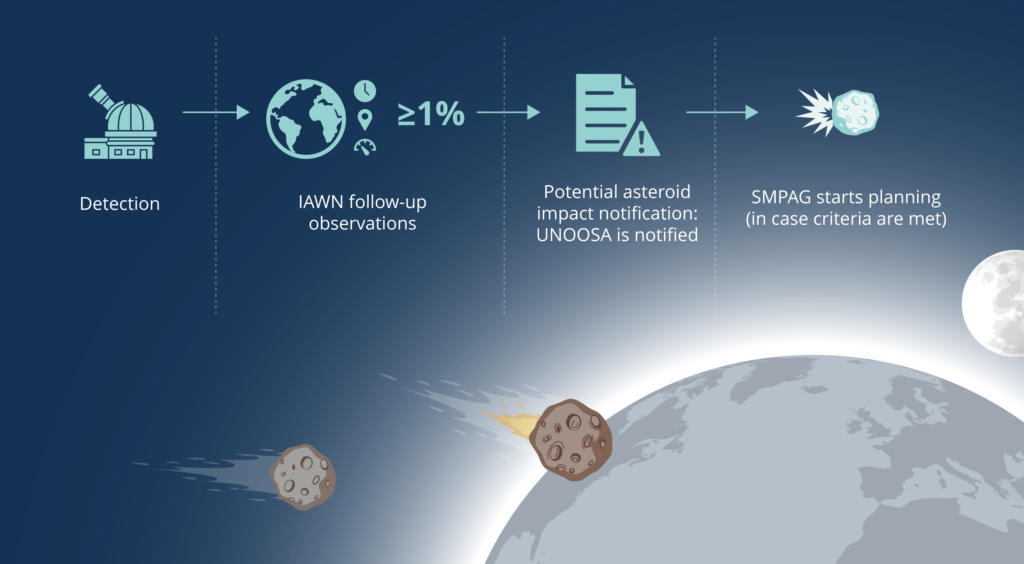
At the start of 2025, UNOOSA was notified of a possible impact of the asteroid designated 2024 YR4 on Earth on Dec. 22, 2032. This was shortly after the Asteroid Terrestrial Last Alert System (ATLAS) station of the University of Hawai’i in Chile first reported a potentially hazardous asteroid 2024 YR4 on Dec. 27, 2024 during near-Earth asteroid search operations for NASA. The worldwide network of observatories of the International Asteroid Warning Network (IAWN) subsequently mobilised teams of astronomers across the globe to conduct follow-up observations, inviting them to submit observations to the Minor Planet Centre, a hub for collecting, verifying and disseminating data on the positions, motions and discoveries of asteroids, comets,
and other small solar system bodies. What followed within days were impact probability calculations, independently verified by multiple authoritative sources, including the three IAWN orbit computation centres: NASA’s Jet Propulsion Laboratory Center for Near-Earth Object Studies, the European Space Agency (ESA)’s Near-Earth Objects Coordination Centre and the NEO Dynamic Site.
On Jan. 29, 2025, the day UNOOSA received notification by IAWN of 2024 YR4’s potential impact, the impact probability was 1.3 per cent. While low, this exceeded the 1 per cent notification threshold that triggers international warning protocols[1]. For the first time since the adoption of the UN Resolution 70/82 International cooperation in the peaceful uses of outer space in 2015, that an asteroid met the minimum reporting criteria, prompting UN-OOSA to issue a formal notification to all UN Member States.
At the same time, the Space Mission Planning Advisory Group (SMPAG) — for which UNOO-SA serves as secretariat — was also informed. SMPAG brings together 20 space agencies with specialised expertise in planetary defence. It provides coordinated advice on possible de-flection or mitigation options when an asteroid exceeding 50 metres in diameter is assessed to have an impact probability greater than 1 per cent within a 50-year timeframe. While SMPAG regularly tests its capabilities on hypothetical cases of asteroid threat scenarios, the 2024 YR4 asteroid provided a real-world test of international response coordination mechanisms for planetary defence.
This was a pivotal moment international cooperation in space. It was the first real-time test of our planetary defence protocols, and it showed that preparedness depends not just on technology, but on trust, transparency, and global coordination.
– Aarti Holla-Maini, Director of UNOOSA
The SMPAG Steering Committee reviewed the available data and the warning timeline for 2024 YR4. During meetings in late January and early February 2025, SMPAG concluded that while the probability met the group’s thresh-olds for monitoring, it was too early for specific mission planning. Therefore, SMPAG continued to closely monitor changes in the impact prob-ability and size estimates[2].
At the time of the initial notification, the asteroid was estimated to be between 40 and 90 metres in size, with the impact risk corridor estimated to extend across the eastern Pacific Ocean, northern South America, the Atlantic Ocean, Africa, the Arabian Sea and South Asia. Further observations by the James Webb Space Telescope in March 2025 resulted in a revised estimate for 2024 YR4’s diameter to be 60 ± 7 metres. If an impact with an asteroid of this size were to occur, it could cause severe blast damage extending up to an 80-kilometre radius from the impact site. Because of its size and speed, an impact with Earth would release energy comparable to 2–30 megatons of TNT — about a thousand times the power of the Hiroshima bomb[3].
While the probability remained extremely low, the situation warranted continuous attention and monitoring. The visibility period for 2024 YR4 would last through early April 2025, after which the asteroid would become too faint to be observable from Earth until 2028. UNOOSA maintained regular communication with IAWN on the asteroid’s trajectory and impact prob-ability, ensuring timely situational awareness to support any required policy or coordination efforts.
The asteroid reached a peak probability of impact with Earth of 3.1 per cent, before eventually dropping to 0.004 per cent (1 chance in 26,000) on Feb. 24, 2025. Through IAWN’s final notification, UNOOSA informed Member States that asteroid 2024 YR4 poses no significant risk of impact with Earth over the next century. IAWN will continue tracking the asteroid to refine estimates of its close approach on Dec. 22, 2032, currently projected to pass safely beyond geosynchronous orbit and possibly even beyond the Moon.
How prepared are we? From risk to resilience: Strengthening global preparedness through the peaceful uses of outer space
The international community has shown that deflecting an asteroid is not only theoretically possible, but also technologically achievable. In 2022, in the first-ever planetary defence technology demonstration mission, NASA’s Double
Asteroid Redirection Test, became the first to successfully alter the movement of a natural celestial body. The mission targeted the asteroid Dimorphos, a small moonlet orbiting the larger asteroid Didymos. Using a kinetic impact deflection technique, the mission demonstrated that Dimorphos’s orbital period around Didymos was reduced by approximately 33 minutes. These measurements have drawn on global expertise, using Earth-based telescopes to assess the mission’s outcomes and inform planning for future planetary defence efforts. This technique could one day be applied to help prevent a potential asteroid impact with Earth.
Confronting the hazard posed by NEOs involves a multifaceted effort: identifying asteroids that could impact our planet, assessing potential risks and developing mitigation strategies to prevent or minimise damage. Such endeavours cannot be undertaken in isolation. They demand a united response from the global community — a demonstration of solidarity and shared responsibility in safeguarding humanity.
Planetary defence is not science fiction — it is a shared responsibility. The risks are real, but so is our collective capacity to act. UNOOSA is committed to ensuring that every country, regardless of its size or resources, has both.
– Aarti Holla-Maini, Director of UNOOSA
2029: International Year of Asteroid Awareness and Planetary Defence
In 2024, the UN General Assembly proclaimed 2029 as the International Year of Asteroid Awareness and Planetary Defence[4], marking it with an extraordinary astronomical event. On April 13, 2029, the asteroid 99942 Apophis will make an exceptionally close — yet safe — approach to Earth, passing at a distance of about 32,000 kilometres, within the orbit of many geostationary satellites. This rare event will offer a spectacular sight, as Apophis becomes visible to billions of people with the naked eye under clear night skies.
While the asteroid poses no threat of impact, its close passage presents an unprecedented scientific opportunity and a powerful remind-er of the importance of global preparedness. Building on this once-in-a-millennium event, the International Year will act as a catalyst for international co-operation, education and public engagement on planetary defence — aiming to inspire humanity to deepen its understand-ing of near-Earth objects and to safeguard our shared cosmic environment.
UNOOSA is entrusted with ensuring that this global initiative is carried out in close collaboration with UN Member States, space agencies, entities of the United Nations system, and relevant international and regional organisations, as well as other key stakeholders from the scientific and academic communities.
The close approach of Apophis provides a rare and compelling opportunity for space agencies, research institutions and private entities to send missions to a near-Earth asteroid.
These missions could advance science, test new technologies or demonstrate capabilities for planetary defence. The International Year aims not only raise awareness of asteroid-related risks and opportunities but also strengthen global capacity in planetary defence, space science and sustainable space governance. It is a reminder that humanity’s greatest achievements in space — such as protecting our planet — depend on collaboration, trust and the shared pursuit of knowledge that transcends borders for the benefit of all.
Romana Kofler is a Programme Management Officer at UNOOSA and supports UN space policy negotiations within COPUOS. As UNOOSA focal point, she works with SMPAG and IAWN in strengthening global response to hazardous asteroids.
Other articles

Catastrophic Climate Change
Governing the unthinkable: Imagination and responsibility in the age of Earth system tipping points At the mouth of Ilulissat Icefjord,…

Ecological Collapse
Ecosystems form the living fabric of the planet, regulating the climate, providing food and water, and maintaining the conditions that make human life possible. Since the mid-1950s, many of these systems have been pushed beyond safe limits. Concentrations of greenhouse gases, the loss of forests and biodiversity and the decline of the marine ecosystem health are accelerating, eroding the stability of the Earth system on which societies depend.

Weapons of Mass Destruction
Multi-Domain Escalation Risk Rapid technological advances and expanding multi-domain warfare are reshaping global security, blurring lines between nuclear and conventional…

Artificial Intelligence
AI in military decision-making: The global governance challenge The race to integrate AI into military command systems is accelerating —…